

By Dr. Kirk Adams
Executive Director, The Institute for Sustainable Diversity and Inclusion
https://i4sdi.org
Editor’s Note — September 2026: The Community Coalition for Sustainable Diversity and Inclusion officially launched! What began as a vision is now a growing community of people committed to fairness, inclusion, equal opportunity, and human dignity for all. Together, we are moving beyond reactive, isolated efforts toward strategic, sustainable, collective power, grounded in courageous communication, shared learning, and meaningful action.
Your voice, experience, and participation can help shape what comes next. Join the Coalition today and stand shoulder to shoulder with people working to build a more just, inclusive, and connected world.
Learn more and become a member today at: https://community.i4sdi.org/coalition-founder.
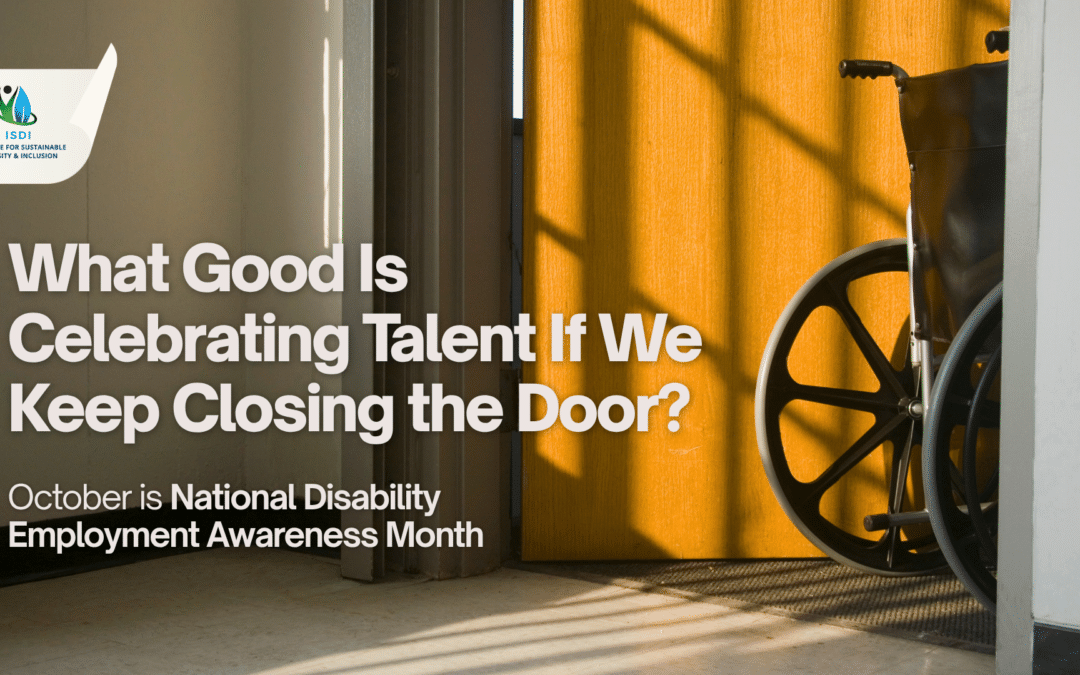
What Good Is Celebrating Talent If We Keep Closing the Door?
October is National Disability Employment Awareness Month. The U.S. Department of Labor has chosen “Celebrating Value and Talent” as its 2026 theme. I’m ready to celebrate.
I’m also ready to ask what happens to talent when the door to opportunity stays closed.
In 2025, about 23 out of every 100 Americans with disabilities had a job, compared with 65 out of every 100 Americans without disabilities. The disability population includes many older adults, but age does not explain away the gap: people with disabilities were less likely to be employed in every age group. Among those ages 16 to 64, only 38 out of 100 were employed.
Think about the human potential behind those numbers. Think about the person who can do the work but cannot get through an inaccessible online application. The candidate who cannot reliably reach an interview because transportation was designed without them in mind. The employee whose manager sees an accommodation as a burden rather than a way to put talent to work.
These are barriers people created. People, we, can change them.
I have spent much of my life working on disability employment, including the research for my dissertation, Journeys Through Rough Country: An Ethnographic Study of Blind Adults Successfully Employed in American Corporations. The people I interviewed had built meaningful careers. Their success took skill and persistence, often alongside the exhausting work of navigating systems that were never designed for them. You can read the dissertation here: https://aura.antioch.edu/etds/467/.
During that work, I also encountered research that made me confront intersectionality within the blind community itself. At the time, roughly 35% of blind people were reported to be in the workforce. Among those who worked, white men who were legally blind but had substantial usable vision had the highest incomes. Totally blind Black women had the lowest. Blindness did not erase the effects of race and gender; those experiences combined to shape whose work was recognized and rewarded.
A job is more than a paycheck in our society. Work can help us answer “What do you do?” and, sometimes, “Who are you?” It can bring purpose, relationships, independence, and a place in the life of a community. Human dignity belongs to everyone, whether employed or not. But when someone wants to work and is shut out, the loss can reach far beyond wages.
And employment is only one place where the design of our institutions shows up in people’s lives.
The Barriers
In 2024, Black women in the United States died from maternal causes at more than three times the rate of white women. A CDC study of high school students found that approximately one in four transgender and questioning students had attempted suicide in the previous year, compared with approximately one in twenty cisgender boys. And CDC data show that infant mortality was higher in rural counties than in large metropolitan counties across most racial and ethnic groups studied.
These are different outcomes, with different causes. None can be reduced to a single barrier or solved by a single program. But each should prompt us to ask who can reach quality care, safety, connection, and opportunity, and what happens when that access is unequal.
We encounter barriers in three environments every day:
- The built environment, from transportation to workplaces and clinics
- The digital environment, from job applications to health information
- The social environment, where expectations, prejudice, and decisions about who belongs can either open a door or close it.
Institutions can reinforce those barriers, or they can take responsibility for removing them.
That is why the Community Coalition for Sustainable Diversity and Inclusion matters to me.
We are bringing together people who know these barriers through lived experience and people who see the inequity around them and are determined to address it. Across disability, race, gender, geography, and other experiences, we can listen closely, share what works, challenge harmful practices, and organize for change.
National Disability Employment Awareness Month asks us to celebrate value and talent.
Let’s make that celebration mean something. Let’s make it easier for people to enter a workplace, build a career, and contribute on their own terms. Then let’s bring the same resolve to the other barriers that keep people from thriving.
Join the Community Coalition for Sustainable Diversity and Inclusion.
If you would also like to help support this work, our GoFundMe is found here.
Our society has built these barriers. Together, we can learn to take them down.
Kirk Adams, PhD
Executive Director
Institute for Sustainable Diversity and Inclusion
www.i4sdi.org
We can’t wait to see you at the next workshop.
Until then, please share this post with anyone you think would be interested.
LinkedIn Facebook Instagram Bluesky Threads