

By Dr. Kirk Adams
Executive Director, The Institute for Sustainable Diversity and Inclusion
https://i4sdi.org
Editor’s Note — September 2026: The Community Coalition for Sustainable Diversity and Inclusion has officially launched! What began as a vision is now a growing community of people committed to fairness, inclusion, equal opportunity, and human dignity for all. Together, we are moving beyond reactive, isolated efforts toward strategic, sustainable, collective power, grounded in courageous communication, shared learning, and meaningful action.
Your voice, experience, and participation can help shape what comes next. Join the Coalition today and stand shoulder to shoulder with people working to build a more just, inclusive, and connected world.
Learn more and become a member today at: https://community.i4sdi.org/coalition-founder.
The Walls Between Us Were Never Meant to Last
There is something I keep noticing as I study social justice calendars.
The sheer depth and breadth of human struggle, resilience, advocacy, identity, and hope is breathtaking.
There are months dedicated to disability awareness, Black history, LGBTQ+ pride, women’s leadership, mental health, Asian American and Pacific Islander heritage, Native sovereignty, poverty awareness, autism acceptance, religious inclusion, immigrant rights, accessibility, environmental justice, and so much more.
Then there are weeks. Days. Commemorations. Calls to action.
And there is only so much calendar to go around.
Twelve months. Fifty two weeks. Three hundred sixty five days.
Which means something powerful happens almost constantly. The causes overlap.
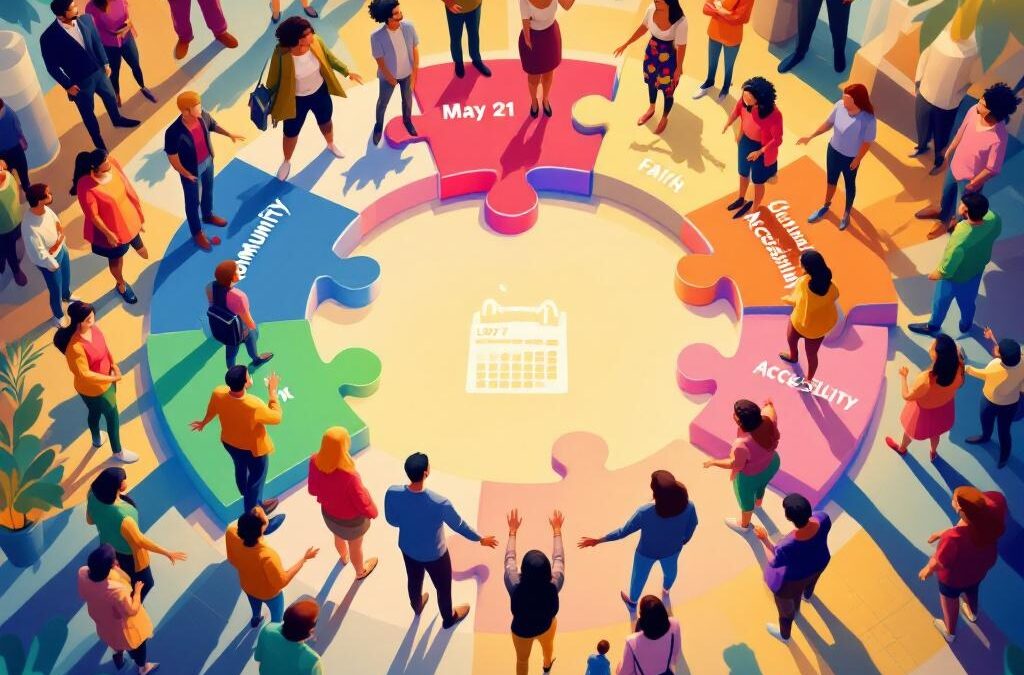
This year, May 21 caught my attention.
The International Day for Cultural Diversity and Global Accessibility Awareness Day fall on the very same day.
Think about that for a moment.
Two movements. Two histories. Two communities that have often operated in separate lanes. Yet on that day, they stand side by side on the calendar, almost as if the universe itself is whispering:
These struggles are connected.
Because they are.
That realization sits at the very heart of why we are building the Community Coalition for Sustainable Diversity and Inclusion.
The Community Coalition for Sustainable Diversity and Inclusion will help members move from reactive, isolated survival mode to strategic, sustainable, collective power.
Too often, people working for justice are isolated inside silos.
Disability advocates over here.
Racial justice advocates over there.
LGBTQ+ leaders somewhere else.
People focused on economic justice in another room entirely.
Many DEI champions feel like they are the only one in the room.
And honestly, sometimes they are.
That isolation is exhausting. It is discouraging. It is strategically dangerous.
Meanwhile, those opposing inclusion efforts are often delighted to keep us fragmented, disconnected, and competing for attention, funding, influence, or legitimacy.
But history teaches us something different.
Dr. Martin Luther King Jr. understood intersectionality long before many of us used that word regularly. The March on Washington was not only about civil rights for African Americans. It was fundamentally tied to economic justice for all people living in poverty.
Justice movements become transformational when they recognize shared humanity and shared struggle.
That is why the Community Coalition for Sustainable Diversity and Inclusion is being intentionally designed to cut across silos.
Everybody means everybody.
Not performatively. Not symbolically. Actually everybody.
We are building a space where disability inclusion leaders can learn from racial justice organizers. Where LGBTQ+ advocates can collaborate with faith leaders committed to human dignity. Where people focused on accessibility, belonging, economic justice, education, healthcare, immigration, workforce equity, environmental justice, and human rights can recognize the connective tissue between their causes.
Because oppression is interconnected.
And liberation must be interconnected too.
That is a radical act.
One of the biggest challenges we continue hearing from people across industries and communities is this:
Isolation and Lack of Community
Many DEI champions feel like the only one in the room.
One of the most important solutions we can provide is simple, but profound:
Design intentional spaces for belonging, not just networking.
That word matters deeply to me.
Belonging.
Not transactional networking. Not performative allyship. Not collecting contacts on LinkedIn.
Real belonging.
Spaces where people can exhale.
Spaces where people can ask hard questions without fear.
Spaces where people can strategize together, solve problems together, support one another, and build sustainable collective action.
That is exactly what we are now creating.

The Launch of The Community Coalition
On Juneteenth, we will launch our GoFundMe campaign to help fund the infrastructure for the coalition, which will be built on the Circle platform.
Then, on July 20, we are targeting the launch of the coalition website and mobile app.
At that time, people will be invited to become founding members through a monthly subscription that will never increase for those early supporters.
More importantly, founding members will help co-create this coalition from the very beginning.
Right now, we are actively defining the initial “spaces” that will exist inside the platform. We want founding members to experience genuine value, engagement, and community from day one.
But we also know something important:
We do not need to pretend we already have every answer.
The coalition will grow based on the voices, needs, and wisdom of the community itself.
What problems are people facing?
What barriers are exhausting them?
What support systems are missing?
What tools, resources, relationships, and rapid response mechanisms would actually help people thrive?
Those answers should not come from one leader or one organization alone.
They should come from all of us.
Together.
The truth is, we are living through a moment when many people feel frightened, exhausted, fragmented, and uncertain about the future of diversity, equity, inclusion, accessibility, belonging, and justice work.
But I also sense something else emerging.
Connection.
Resistance.
Solidarity.
A growing realization that isolated survival is not enough anymore.
We need each other.
And perhaps that is the most radical realization of all.
We can’t wait to see you at the next workshop.
Until then, please share this post with anyone you think would be interested.
LinkedIn Facebook Instagram Bluesky Threads