

By Effenus Henderson
Reprinted with permission
Subscribe to https://effenus.substack.com/
Founder and Principal of HenderWorks Consulting and the creator of the SPINE Social Systems Leadership Model™ and the Architecture of Inclusion™www.i4sdi.org
Co-Director of the Institute of Sustainable Diversity and Inclusion https://i4sdi.org
The Questions of the Backtalkers
Reflections on an Evening with Kimberlé Crenshaw and the Democratic Questions of Our Time
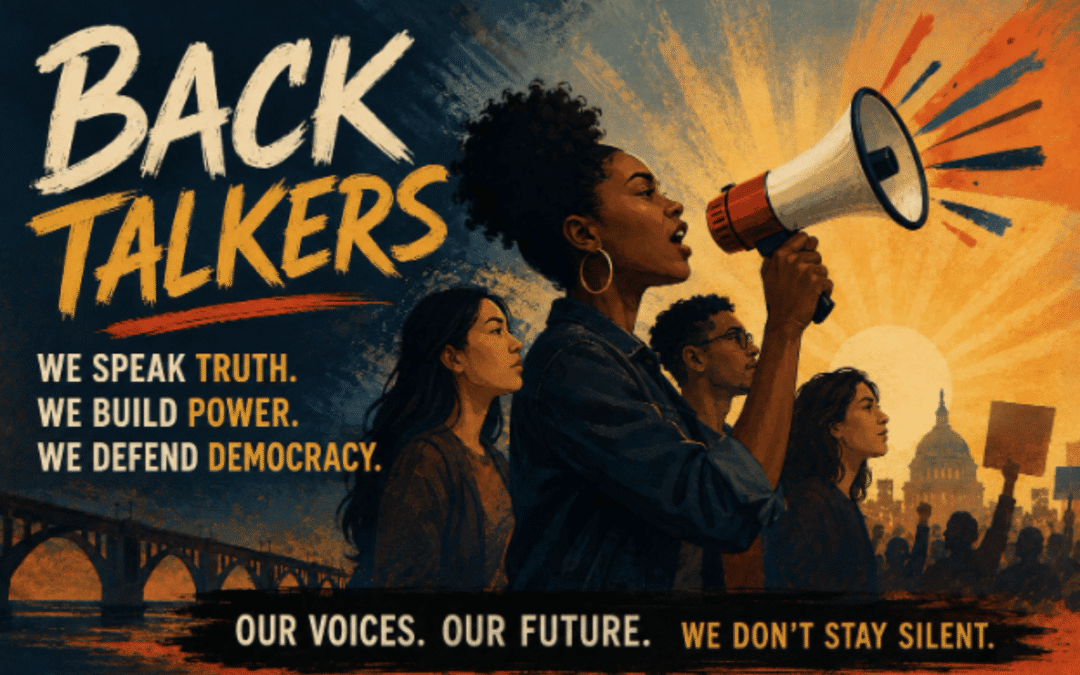
Last night, I attended an extraordinary evening with Kimberlé Crenshaw centered around themes from her new book, BackTalker.
And in many ways, the title itself framed the entire evening.
Because this was not simply a conversation about law, race, or theory.
It was a conversation about voice.
About who gets heard.
Who gets erased.
Who gets punished for speaking.
And why democratic societies so often become uncomfortable when marginalized communities refuse silence.

What struck me immediately was how deeply reflective and historically grounded the conversation was.
Professor Crenshaw did not present Critical Race Theory or intersectionality as abstract ideological concepts detached from ordinary life. Instead, she situated them where they have always belonged — inside lived experience.
- She reminded us that Critical Race Theory emerged from a simple but uncomfortable observation: even after formal segregation ended, racial inequality continued shaping institutions, opportunities, and outcomes in profound ways.
- CRT challenged the comforting assumption that once discrimination becomes less explicit, inequality naturally disappears.
- Intersectionality emerged from another reality: people do not experience life through a single category of identity.
- Race intersects with gender.
- Gender intersects with class.
- Class intersects with sexuality, disability, culture, immigration status, and power.
And many people — especially Black women — were living realities that existing legal frameworks could not fully see or explain.
One of the most powerful aspects of the evening was Professor Crenshaw’s emphasis that intersectionality was not invented first in academia.
It was recognized first in people’s lives.
People already understood layered exclusion long before the terminology existed.
They understood what it meant to:
- be dismissed in rooms where others were heard,
- navigate institutions that questioned their credibility,
- absorb humiliation disguised as professionalism,
- be expected to “just take it,”
- or feel simultaneously hyper visible and invisible at the same time.
And perhaps that is why the concept of “BackTalkers” resonated so deeply throughout the room.
Because “backtalk” in this framework is not disrespect.
It is democratic refusal.
It is the refusal to quietly normalize inequality, erasure, intimidation, or historical amnesia.
It is the belief that somebody must answer the question.

My Reflection on the Evening
As I listened throughout the night, I kept thinking about how much of our current political and cultural moment revolves around the policing of language, memory, and truth.
We are living through a period where discussions about race, equity, inclusion, history, and democratic participation are increasingly treated as dangerous rather than necessary.
And yet what Professor Crenshaw illuminated so clearly is that refusing to discuss race does not eliminate racialized outcomes.
It simply protects systems from scrutiny.
That realization hung over the room all evening.
There was an emotional honesty in the audience that I found deeply moving. People were not simply there to consume ideas. They were trying to orient themselves inside a democratic moment that feels increasingly unstable.
The audience carried visible fatigue.
But also determination.
There was grief in the room.
But also clarity.
There was anxiety.
But also refusal.
And perhaps most importantly, there was recognition that silence itself can become political surrender.
I left the evening thinking about how much courage it takes for people to continue speaking honestly in environments increasingly hostile to complexity, history, and nuance.
And that is where the audience questions became so revealing.
The Questions Became the Backtalk
What became increasingly clear as the evening progressed was that the audience questions were not secondary to the event.
They were the event.
Professor Crenshaw did not have time to fully unpack every question posed online and in the room, but in many ways, her talk had already begun answering them indirectly through the frameworks she shared.
The questions revealed the emotional and democratic condition of the moment.
Some reflected exhaustion:
“As a Black woman who’s exhausted by always having to step up but also wants to do her part, what are we to do?”
Others reflected survival inside systems that claim justice while reproducing harm:
“What advice do you have for those of us who have been punished by the same systems that claim to support survivors?”
Some reflected coalition anxiety:
“Why is solidarity still so difficult?”
Others reflected democratic fear:
“What can we legally do in this moment to fight what feels like Jim Crow 2.0?”
And others reflected the search for hope and endurance:
“Is there such a thing as resistance through joy?”
“What gives you hope in this moment?”
One of the most profound questions asked was:
“Who supported and empowered you when you were young to backtalk?”
That question stayed with me.
Because somewhere along the way, someone teaches you whether your voice matters.
Someone teaches you whether speaking up is dangerous or necessary.
Someone teaches you whether democracy belongs to you too.
And for many communities historically pushed to the margins, “backtalk” has often been less about rebellion and more about survival.
The Major Themes Hidden Inside the Questions
As I reflected afterward, several themes emerged from the questions that defined the emotional architecture of the evening.
1. Democratic Anxiety
Many questions reflected deep concern about democratic erosion:
- attacks on voting rights,
- educational censorship,
- white Christian nationalism,
- demographic backlash,
- institutional retrenchment,
- and the normalization of inequality.
People were asking:
What happens when democratic institutions stop protecting pluralism equally?
2. Exhaustion and Sustainability
There was visible concern about emotional fatigue.
People wanted to know:
- how to keep speaking,
- how to avoid burnout,
- how to sustain resistance,
- and how to continue without losing themselves spiritually or emotionally.
3. Coalition and Solidarity
Repeatedly, questions returned to solidarity:
- Black and Latino solidarity,
- Black and Asian solidarity,
- coalition-building,
- movement fragmentation,
- and collective organizing.
There was recognition that division is often strategic.
And that systems of power survive when marginalized communities remain isolated, exhausted, or suspicious of one another.
4. Historical Truth
Several questions challenged the audience to reconsider whether current democratic tensions are actually new.
One Native participant profoundly reframed the discussion by observing that from Indigenous perspectives, America may be functioning exactly as it was originally designed.
That intervention shifted the room.
It forced deeper reflection about whether exclusion is merely a deviation from democracy — or whether it has historically been embedded within its structures.
5. Joy as Resistance
One of the most beautiful moments came from the question:
“Can joy itself become resistance?”
That question mattered because it reminded the room that survival is not only about critique.
It is also about imagination.
Music.
Humor.
Love.
Art.
Community.
Belonging.
Marginalized communities have long used joy as a survival technology against dehumanization.
Perhaps joy itself is evidence that oppression has not fully conquered the human spirit.
Final Reflection
By the end of the evening, what became unmistakably clear to me was this:
People are searching for orientation.
Not simply political answers.
But moral orientation.
Democratic orientation.
Historical orientation.
Human orientation.
They are trying to understand how to remain courageous in a moment increasingly defined by backlash, polarization, distortion, exhaustion, and democratic strain.
And maybe that is why BackTalkers feels so timely.
Because this moment is demanding more than observation.
It is demanding participation.
Voice.
Memory.
Solidarity.
Courage.
And the willingness to speak even when silence would be easier.
The questions themselves became evidence that people are no longer willing to quietly absorb the moment.
They are trying to find language for what they feel.
They are trying to build community around what they fear.
And they are preparing — thoughtfully, emotionally, democratically — to talk back.
We can’t wait to see you at the next workshop.
Until then, please share this post with anyone you think would be interested.
LinkedIn Facebook Instagram Bluesky Threads