

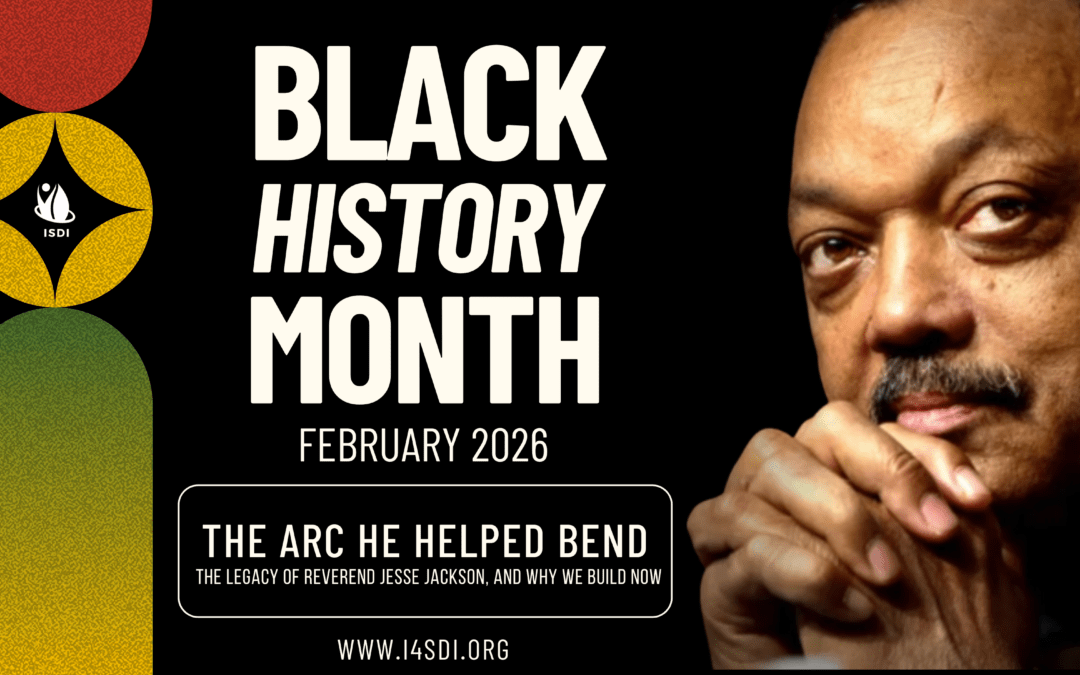
By Dr. Kirk Adams, Executive Director, and Effenus Henderson, Co-Founder and Board Member, Institute for Sustainable Diversity and Inclusion (ISDI) www.i4sdi.org
Black History Month is more than commemoration. It is a map — a reminder of where courage lived and how sustained struggle reshaped systems once thought immovable.
The fight for justice led by African Americans expanded freedom far beyond one community. It opened pathways later walked by women seeking equality, people with disabilities demanding access, immigrants asserting dignity, and LGBTQ+ communities claiming visibility and humanity. These movements did not emerge separately; they grew from the moral groundwork laid by Black freedom struggles.
Among the leaders who helped bend that arc was Reverend Jesse Jackson. As we reflect on his passing, we also reflect on the unfinished work his life calls us to continue.
Dr. Kirk Adams: The Architecture of Courage
Jesse Jackson stood beside Reverend Dr. Martin Luther King, Jr. during the movement’s most dangerous moments, including Memphis in 1968. After King’s assassination, Jackson did not retreat — he advanced the work.
Through Operation Breadbasket, he transformed moral conviction into economic leverage, pressing corporations to hire Black workers and invest in neglected communities. Through Operation PUSH and the Rainbow Coalition, he expanded the circle of justice, bringing together diverse communities around shared economic and democratic interests. He understood that progress advances when people recognize their connected struggles.
His presidential campaigns in 1984 and 1988 were structural interventions, making visible the possibility of national leadership reflecting America’s full diversity. Those campaigns helped open doors later walked through by leaders such as President Barack Obama and Vice President Kamala Harris.
Progress, in America, is often a relay. Jesse Jackson carried the baton forward.
Effenus Henderson: Making Belonging Structural, Not Symbolic
I knew Jesse Jackson not simply as a historic figure, but as a builder — someone who understood that movements endure only when they become structure.
His leadership expanded participation and redefined who belonged at the center of the American story. The Rainbow Coalition rejected scarcity thinking and affirmed that justice grows when communities recognize their shared stake.
Long before institutions spoke the language of equity and inclusion, Jackson translated moral vision into economic access and influence. He understood that representation matters, but lasting change requires participation and power.
His legacy feels urgent today. We are living through renewed resistance to equity and inclusion — a reminder that progress always generates backlash. For me, his legacy is not nostalgia. It is instruction. If belonging is to endure, it must become infrastructure — embedded into how institutions operate and how opportunity is shared.
Jesse Jackson widened the circle. Our responsibility now is to make sure it holds.
The Moment We Are In
Symbols signal whose contributions are remembered and whose stories shape national identity.
Whether or not Jesse Jackson receives formal national recognition, his legacy exposes a deeper truth: we live in a moment of division where even architects of democratic expansion face selective remembrance. At the same time, diversity, equity, inclusion, and accessibility efforts face organized pressure and retrenchment. Programs are dismantled, leaders isolated, and institutions urged to retreat.
This is not accidental. Progress produces resistance. And resistance, left unanswered, can reverse gains built over generations.
Why We Build Now
This is why the Institute for Sustainable Diversity and Inclusion is launching the Community Coalition for Sustainable Diversity and Inclusion — not as a reaction, but as infrastructure.
The coalition ensures leaders committed to equity are never isolated and transforms individual effort into collective strength. By bringing together nonprofits, businesses, educators, and community leaders, we aim to build systems that endure beyond political cycles and moments of backlash. Not to preserve the past. To extend it.
The Relay Continues
Black History Month reminds us that progress is a continuum shaped by people willing to act before outcomes are certain.
Jesse Jackson was one of those people. His life teaches that leadership is measured not only by achievement, but by the pathways created for others.
At ISDI, we accept the responsibility to help build what comes next — together. Because the arc of justice does not bend on its own.
It bends when people choose to bend it — and build structures strong enough to hold