

By Dr. Kirk Adams
Executive Director, The Institute for Sustainable Diversity and Inclusion
https://i4sdi.org
Editor’s Note — September 2026: The Community Coalition for Sustainable Diversity and Inclusion has officially launched! What began as a vision is now a growing community of people committed to fairness, inclusion, equal opportunity, and human dignity for all. Together, we are moving beyond reactive, isolated efforts toward strategic, sustainable, collective power, grounded in courageous communication, shared learning, and meaningful action.
Your voice, experience, and participation can help shape what comes next. Join the Coalition today and stand shoulder to shoulder with people working to build a more just, inclusive, and connected world.
Learn more and become a member today at: https://community.i4sdi.org/coalition-founder.
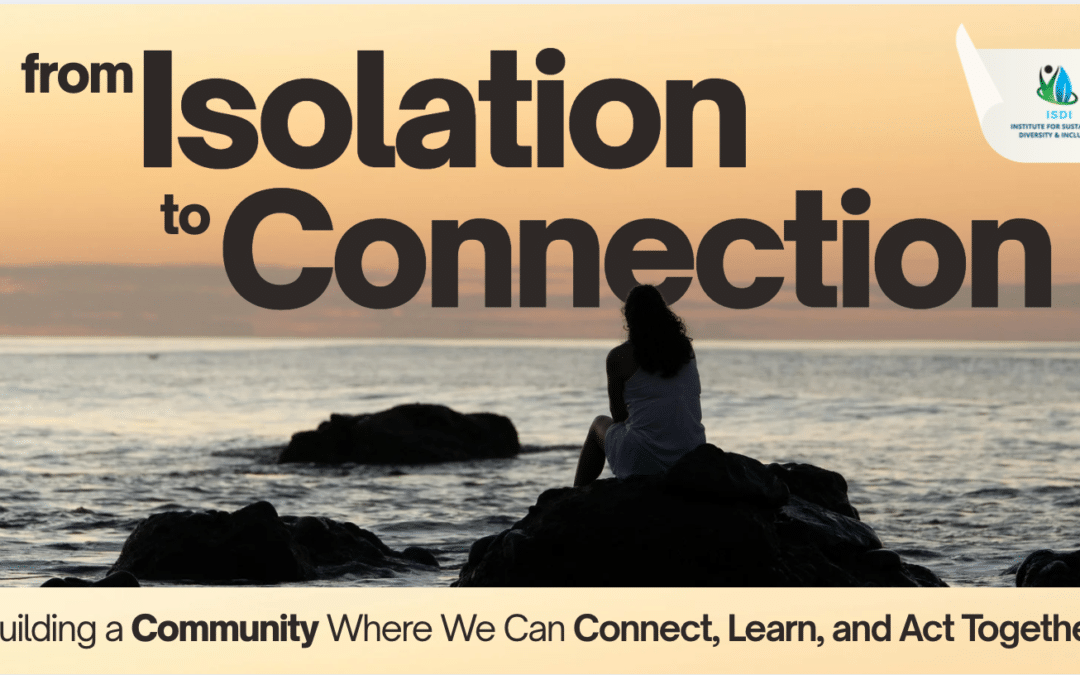
From Isolation to Connection: Building a Community Where We Can Connect, Learn, and Act Together
What if inclusion is not only about who is invited into the room, but also about what happens between us once we arrive?
What if belonging is not simply a feeling, but something we create through relationships, shared power, courageous conversations, and collective action?
These are the kinds of questions we want to explore in the Community Coalition for Sustainable Diversity and Inclusion.
The Coalition is a place for people who care deeply about diversity, equity, inclusion, accessibility, belonging, social justice, human rights, and human dignity. It is also a learning community; a space where intellectually curious people can encounter new ideas, share frameworks and methodologies, question familiar assumptions, and develop more refined ways of understanding inclusion.
One framework that has recently deepened my thinking is Relational-Cultural Theory, commonly called RCT.
Discovering a New Lens
I earned my PhD in Leadership and Change from Antioch University. My doctoral journey introduced me to a rich range of ideas about identity, culture, power, leadership, and social change. My dissertation chair, Dr. Philomena Essed, profoundly influenced my understanding of human dignity, everyday injustice, and the responsibility of leaders to create environments in which every person is fully valued.
My dissertation, Journeys Through Rough Country: An Ethnographic Study of Blind Adults Successfully Employed in American Corporations, examined the lived experiences of blind adults who had achieved meaningful employment in corporate America. I explored the relationships, experiences, personal agency, and organizational conditions that contributed to their success.
You can read the dissertation here: https://aura.antioch.edu/etds/467/
Although relationships were central to my research, I was not introduced to Relational-Cultural Theory during my doctoral studies. Sometimes the most important intellectual discoveries arrive after the diploma is framed and the dissertation dust has settled.
Fortunately, learning does not end at graduation.
Living in Seattle, home to one of Antioch University’s campuses, has allowed me to remain engaged with the Antioch community. I have had the honor of speaking on a panel for third-year doctoral students and attending presentations that continue to stretch my thinking.
One especially meaningful experience was hearing Dr. Harriet Schwartz present on RCT with Dr. Elizabeth Holloway, one of my professors in the Leadership and Change program. Dr. Schwartz is a leading scholar of relational practice in higher education and the author of Connected Teaching: Relationship, Power, and Mattering in Higher Education. Her work examines how connection, disconnection, identity, power, and emotion shape teaching and learning. Dr. Holloway’s mentorship helped introduce Dr. Schwartz to RCT and influenced her relational approach to scholarship and practice.
Their work helped me recognize that RCT offers much more than a theory of interpersonal relationships. It provides a powerful lens for examining leadership, institutions, culture, oppression, and social transformation.
We Grow Through Connection
Relational-Cultural Theory emerged from the work of Jean Baker Miller, Judith Jordan, Janet Surrey, Irene Stiver, and other scholars associated with the Stone Center at Wellesley College.
At its heart is a deceptively simple idea: human beings grow through and toward connection.
RCT challenges the myth that healthy development is primarily a journey toward independence and self-sufficiency. Instead, it recognizes that we are relational beings. We become more fully ourselves through relationships characterized by authenticity, mutual empathy, respect, shared power, and meaningful participation.
This does not mean ignoring conflict or pretending that every relationship is harmonious. Authentic connection requires the courage to acknowledge differences, confront harm, examine power, and repair disconnection.
The “cultural” in Relational-Cultural Theory is equally important. Relationships do not exist in a vacuum. Racism, ableism, sexism, economic inequality, heterosexism, ageism, and other systems of power shape who is heard, who is believed, who is welcomed, and who is expected to adapt.
That makes RCT highly relevant to anyone working for inclusion and social justice.
When Isolation Is Socially Produced
One of the most powerful RCT concepts I have encountered is “condemned isolation.”
Condemned isolation is more than being alone. It describes the painful experience of feeling disconnected while also believing that the disconnection results from something fundamentally wrong or unacceptable about oneself. A person may long for connection but fear that greater authenticity will lead to rejection.
For people with disabilities, this form of isolation is often socially manufactured.
Inaccessible workplaces, segregated programs, communication barriers, unemployment, low expectations, institutionalization, and exclusion from informal networks all send a message: “You do not fully belong here.”
When people receive that message repeatedly, external ableism can become internalized as shame, self-doubt, or a reluctance to express access needs. People may feel pressured to minimize their disabilities, work twice as hard for equal recognition, or express endless gratitude for accommodations that should have been available from the beginning.
RCT helps us see that the answer is not to “fix” an isolated individual. We must transform the relationships, cultures, and systems producing the isolation.
That transformation requires several shifts:
- Accessibility must open the door, but belonging must shape what happens inside.
- Presence must be accompanied by influence, participation, and shared power.
- Interdependence must be recognized as a human reality, not treated as a personal failure.
- Authenticity must be welcomed, so people do not have to conceal their identities, disabilities, pain, or access needs to remain accepted.
- When disconnection or exclusion occurs, organizations must acknowledge the harm, change the conditions that caused it, and work intentionally to rebuild trust.
Inclusion becomes meaningful when people are not merely present, but known, valued, heard, missed when absent, and able to contribute to decisions that affect their lives.
A Community of Scholar-Practitioners
I am grateful to Dr. Ileya Grosman, who regularly convenes a community of scholar-practitioners interested in exploring Relational-Cultural Theory. I have participated in several of these gatherings and deeply appreciate their combination of intellectual rigor, lived experience, reflection, and practical application.
On November 13, I will join Ileya’s RCT-informed Leadership and Change group to explore disability lived experience through a relational-cultural lens. We will consider how social structures create barriers and disconnection—and how relationships rooted in authenticity, mutuality, dignity, and shared power can advance disability inclusion.
I expect the conversation to generate more questions than answers. That is not a flaw. It is part of serious learning.
The most useful frameworks do not hand us tidy slogans. They help us notice what we have overlooked, name what we have experienced, and imagine new possibilities for action.
This Is What the Coalition Can Become
Relational-Cultural Theory is one of many models and methodologies we hope members will bring into the Community Coalition for Sustainable Diversity and Inclusion.
Our community includes people with different identities, disciplines, professions, histories, and lived experiences. Each person carries knowledge that others may never have encountered. When we share that knowledge generously, and examine it critically together, we enlarge everyone’s capacity to understand and act.
The Coalition is not intended to be an echo chamber where people already fluent in the language of inclusion congratulate one another for agreeing. Nor is it a graduate seminar with a monthly subscription fee and surprise homework. It is a living community where scholarship meets experience and ideas lead to action.
We want to examine the deeper questions:
What creates genuine belonging?
How does power shape connection?
What does dignity require of leaders and institutions?
How can we repair relationships after exclusion or harm?
How do we move from isolated survival to sustainable collective power?
And how might our organizations and communities change if we understood connection not as a pleasant extra, but as essential to human growth and social transformation?
If those questions stir your curiosity, there is a place for you in this community.
Bring the framework that has shaped your thinking. Bring the question that keeps tugging at you. Bring your scholarship, your professional experience, your lived experience, and your unfinished ideas.
Let us think together, learn together, and create the conditions in which more people can live with connection, agency, belonging, and dignity.
Learn more and join the Community Coalition for Sustainable Diversity and Inclusion:
https://community.i4sdi.org/coalition-founder/
Kirk Adams, PhD
Executive Director
Institute for Sustainable Diversity and Inclusion
www.i4sdi.org
We can’t wait to see you at the next workshop.
Until then, please share this post with anyone you think would be interested.
LinkedIn Facebook Instagram Bluesky Threads