

By Effenus Henderson
Reprinted with permission
Subscribe to https://effenus.substack.com/
Founder and Principal of HenderWorks Consulting and the creator of the SPINE Social Systems Leadership Model™ and the Architecture of Inclusion™www.i4sdi.org
Co-Director of the Institute of Sustainable Diversity and Inclusion https://i4sdi.org
Diversity Has Arrived in Our Urban Centers—Yielding a Power the Federal Government Is Desperate to Contain
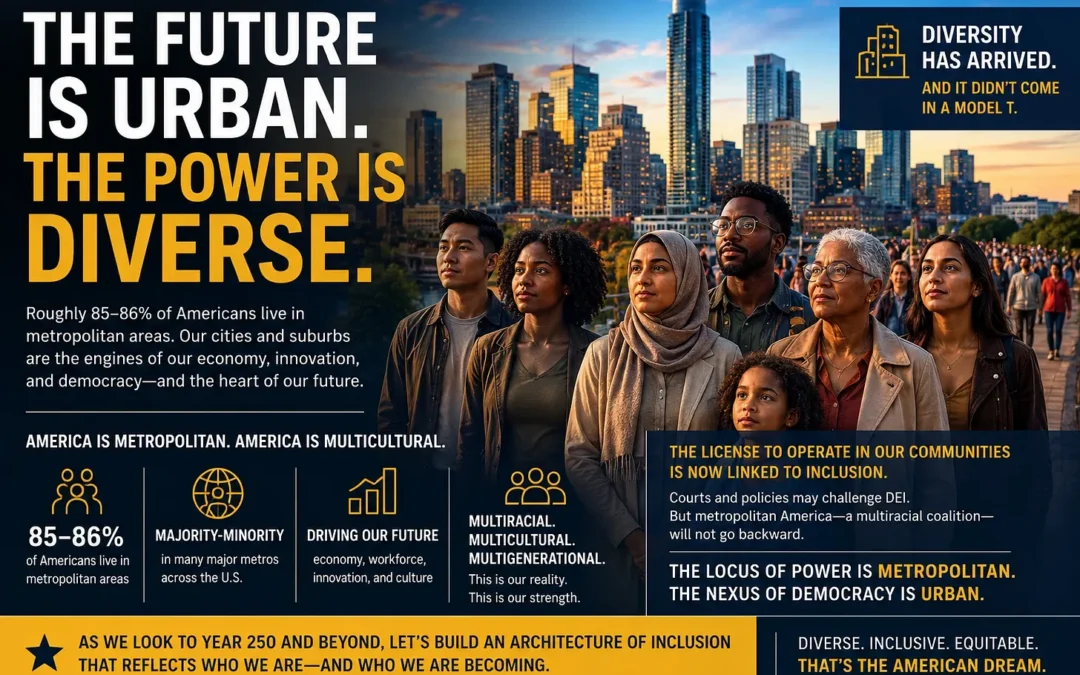
The Future is Urban. The Power is Diverse.
What is being called a culture war is really a power struggle. And the numbers—from city halls to statehouses to GDP reports—make clear who is winning. Which is exactly why the assault has begun.
OPINION · SHIFTING POWER · ECONOMIC ARGUMENT ·Drawing on current U.S. demographic, political, and economic research

The Numbers Don’t Lie—And That’s the Problem
Before we can understand why urban centers are under coordinated federal attack, we have to understand what those urban centers have actually become. Not in theory. In fact. In the census data. In the election returns. In the names on the doors of city halls, statehouses, and Senate offices from Atlanta to Albuquerque.
The United States is no longer the country some in Washington are governing as if it still is. Nearly 86% of Americans now live inside metropolitan systems—interconnected urban and suburban ecosystems that are multiracial, multilingual, multigenerational, and globally connected. Within those systems, the demographic transformation is not approaching. It has arrived.
THE DEMOGRAPHIC REALITY — CITY BY CITY
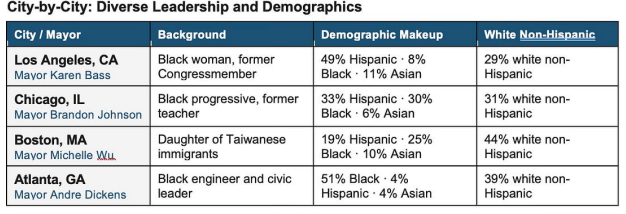
Houston, the fourth-largest city in America, is now 44% Hispanic, 23% Black, and 7% Asian. White non-Hispanic residents comprise roughly 24% of the population.
Miami is approximately 70% Hispanic or Latino. Los Angeles is 49% Hispanic and 29% white non-Hispanic. Dallas is 42% Hispanic and 24% Black. Atlanta is over 51% Black. Chicago is 33% Hispanic and 30% Black. In New York City—the financial capital of the world—white non-Hispanic residents account forroughly 30% of the population
These are not projections. These are the people who are already there. Already working. Already voting. Already governing.
The suburbs—long imagined as a white cultural counterweight to urban diversity—have undergone their own transformation. Suburban counties surrounding Atlanta, Houston, Dallas, Phoenix, and Seattle now contain large and growing immigrant populations, expanding Black middle-class communities, multiracial households, and multilingual school systems. The old binary of urban diversity versus suburban whiteness is a demographic ghost story.
The Shifting Power—From Population to City Hall
Demographic change has now fully converted into political power. The people have not just arrived. They have organized. They have voted. They have run. And they have won.
POWER SHIFT — MAYORS GOVERNING MAJOR U.S. CITIES
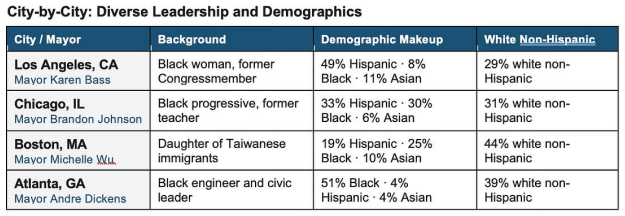
Karen Bass, a Black woman, governs Los Angeles—the second-largest city in the United States and the entertainment capital of the world. Brandon Johnson, a Black progressive, leads Chicago. LaToya Cantrell, a Black woman, runs New Orleans. Muriel Bowser governs the nation’s capital. Michelle Wu—the daughter of Taiwanese immigrants—is the mayor of Boston.
Andre Dickens leads Atlanta. London Breed, a Black woman who grew up in public housing, ran San Francisco. These are not symbolic appointments. These are governing executives managing billions in public budgets, negotiating with federal agencies, and setting policy for millions of people
The State-Level Power Shift—Governors, Senators, and the New Map
The power shift is not confined to city halls. It has moved upstream—into statehouses, Senate chambers, and the emerging class of national leaders who are rewriting what American political leadership looks and sounds like.
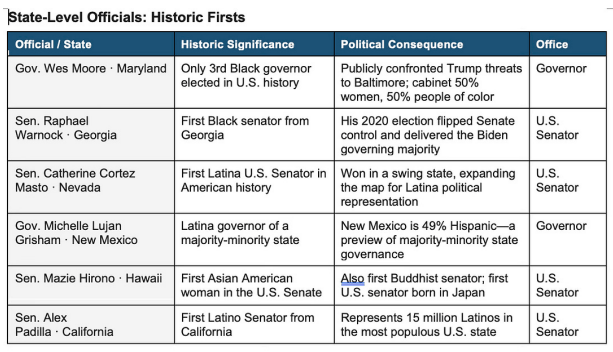
Wes Moore of Maryland became the first Black governor in his state’s history—and only the third ever elected in U.S. history—when he took office in 2023. His administration has appointed a cabinet in which more than 50% of members are women and 50% are people of color.
When the Trump administration threatened to deploy the National Guard to Baltimore and called the city a “hellhole,” it was Governor Moore—a Black Army combat veteran—who publicly challenged the characterization and invited the president for a public safety walk. That is not a symbolic act. That is a governor governing.
POWER SHIFT — STATEHOUSES AND THE SENATE FLOOR
Raphael Warnock of Georgia—the first Black senator ever elected from that state—holds a seat that not long ago defined the old order of Southern Democratic politics. His 2020 election, alongside Jon Ossoff, flipped the Senate and delivered the Biden administration its governing majority. That happened in Georgia.
Catherine Cortez Masto of Nevada became the first Latina ever elected to the U.S. Senate. Michelle Lujan Grisham governs New Mexico. Alex Padilla became the first Latino Senator from California. Mazie Hirono of Hawaii is the first Asian American woman and first Buddhist to serve in the U.S. Senate.
Tammy Duckworth—a Thai American Iraq War veteran who lost both legs in combat—sits in the United States Senate. In the 119th Congress, 28% of House members are Black, Hispanic, Asian, or Native American—a record. More than 84% of those members are Democrats.
In the 119th Congress, 28% of House members are Black, Hispanic, Asian, or Native American—a record. More than 84% of those members are Democrats.
These are not isolated breakthroughs. They are a pattern. A pipeline. A political infrastructure built, election cycle by election cycle, from school boards to statehouses to the Senate floor—and it is accelerating, not slowing down.
“The shift isn’t coming. It came. The question Washington is now scrambling to answer is: what do you do when the people you spent decades marginalizing are now running the institutions?”
The Economic Argument—Follow the Money
For anyone who wants to reduce the attack on urban centers to a political or cultural argument, here is an economic one that is harder to dismiss: attacking metropolitan America is an act of economic self-destruction. Because metropolitan America is not just where diverse populations live. It is where the American economy actually runs.
According to the U.S. Conference of Mayors’ 2025 Metro Economies Report—prepared by S&P Global Market Intelligence—metro areas accounted for 90.8% of national GDP, 92.1% of all wages and salaries, and 88.2% of all employment in the United States in 2024. The contribution of metro economies to U.S. economic growth has increased for five consecutive years.
THE METRO ECONOMY — WHAT’S ACTUALLY AT STAKE
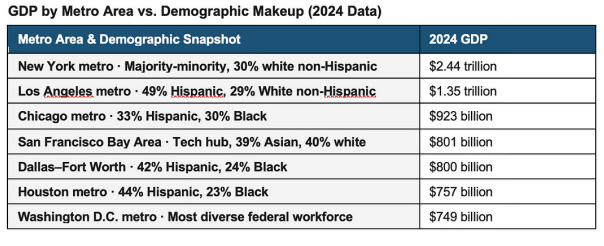
The New York metropolitan area alone generated $2.44 trillion in GDP in 2024—making it, if it were a nation, the eighth-largest economy on earth, larger than Canada’s entire economy. Los Angeles produced $1.35 trillion. Chicago generated $923 billion. The San Francisco Bay Area— home to the global technology industry—produced $801 billion. Dallas Fort Worth generated $800 billion. Houston $757 billion. Washington D.C. $749 billion.
Those seven metropolitan areas alone—all majority-minority or rapidly diversifying—generated more than $7.8 trillion in annual economic output. For reference, the entire GDP of Germany, the world’s third largest economy, is roughly $4.5 trillion.
GDP by Metro Area vs. Demographic Makeup (2024 Data)
Consider what that means. The federal government is waging a systematic campaign of defunding, intimidation, and destabilization against the exact metropolitan ecosystems that generate nearly the entirety of the nation’s economic output. It is targeting the cities where the workforce lives, where innovation is produced, where taxes are collected, where ports operate, where hospitals run, and where universities educate the next labor force.
The brutal irony: you cannot hurt these cities without hurting the economy that funds the federal government itself. The tax base of metropolitan America is the tax base of the United States. There is no separating the two.
Why Urban Centers Are the Real Target
Strip away the rhetoric about “merit,” “colorblindness,” and “anti-wokeness,” and the underlying fear becomes visible: the fear that Black and Brown Americans, having arrived in numbers that now constitute governing majorities in metropolitan America, will use institutional power the same way every other majority has historically used it—to
shape policy, culture, and opportunity in ways that reflect their interests and values.
EVERY TARGET IS THE SAME TARGET
Defund the cities—destabilize the institutions where new power is most concentrated. Attack the mayors—force diverse governing coalitions into defensive postures rather than transformative ones. Gut the school boards—slow the formation of the next generation of civically engaged, pluralist leaders. Strip DEI—signal to corporate America, higher education, and hospitals that alignment with metropolitan demographic reality carries a federal penalty.
It is a strategy of attrition against an irreversible demographic and economic reality. And it will fail. Not because of idealism. Because of arithmetic. You cannot govern 91% of the nation’s GDP out of existence with an executive order.
The Youngest Americans Have Already Decided
In dozens of major metropolitan school systems, there is no racial majority. The children in classrooms in Houston, Dallas, Miami, Los Angeles, Atlanta, Phoenix, and New York City are already living the pluralistic America that some in Washington claim is a radical imposition. For them, it is simply Tuesday. It is their neighborhood, their
lunch table, their team, their family.
Hispanic Americans have added roughly 20 million people over the last two decades. The multiracial population nearly doubled between 2010 and 2020 to more than 33 million people. In 2020, for the first time in American history, the non-Hispanic white population declined in absolute numbers. Not as a share. In total count. The demographic transition is not theoretical. It is already in the rearview mirror.
Diversity has arrived in our urban centers. It is running them—from city halls to statehouses to Senate chambers to the boardrooms that generate 91% of the nation’s GDP.
No federal offensive, however legally armored or politically coordinated, can relocate 86% of the American population, unelect the governors and mayors already governing, un-enroll the generation already in school, or undo the economic architecture already written into the GDP data. The only question that remains—the one America will spend the next generation answering—is whether its governing architecture will be honest enough to reflect the nation that already exists.
Or whether it will exhaust itself trying to contain the one it can no longer pretend doesn’t.
By Effenus Henderson
Reprinted with permission
Subscribe to https://effenus.substack.com/
Founder and Principal of HenderWorks Consulting and the creator of the SPINE Social Systems Leadership Model™ and the Architecture of Inclusion™www.i4sdi.org
Co-Director of the Institute of Sustainable Diversity and Inclusion https://i4sdi.org
We can’t wait to see you at the next workshop.
Until then, please share this post with anyone you think would be interested.
LinkedIn Facebook Instagram Bluesky Threads